
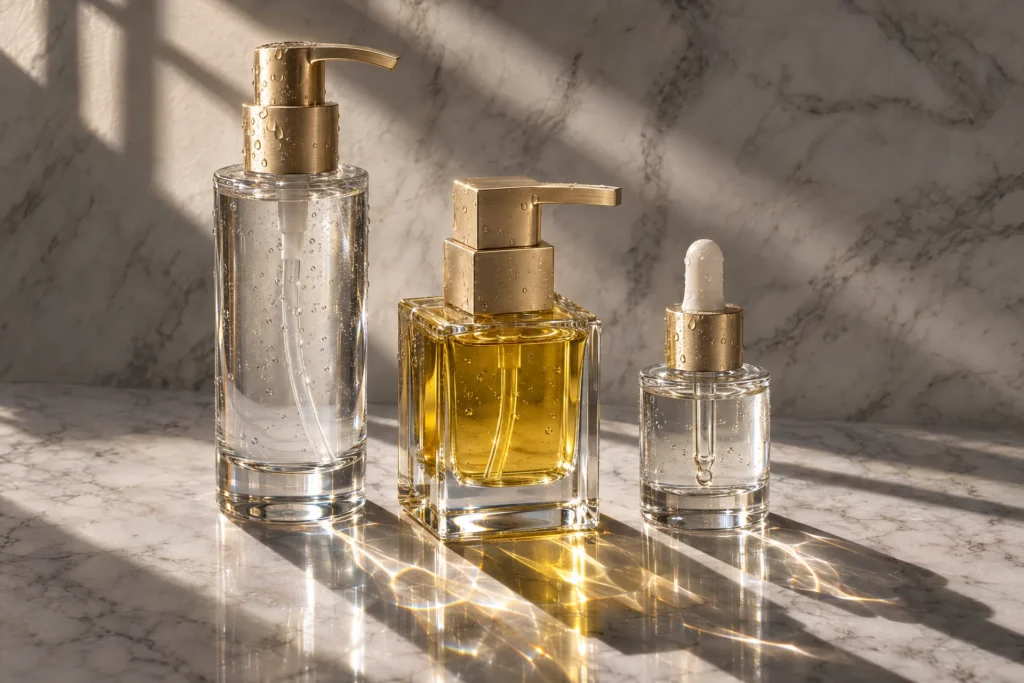
Choosing a glass bottle for a serum, a cream or a cosmetic oil seems simple as long as you are looking at catalogue photos. Two 50 ml bottles can have the same capacity and an almost identical silhouette, yet give a very different result as soon as you hold them.
In one, the glass is clear, the base is well proportioned and the pump travels smoothly to the end of its stroke. In the other, you immediately notice the mould seam along the side, the glass turns greenish where it thickens and the cap does not close perfectly straight.
When designing a high-end cosmetic line, these technical details make the difference: the composition of the glass, the distribution of weight, the precision of the neck and the durability of the decoration. Assessing them one by one on samples shows where it is really worth investing and which choices risk raising costs without improving the finished product.
1. What “Type III glass” really means
The term “Type III glass” often appears in technical data sheets and purchase specifications. It is sometimes even picked up in brands’ marketing copy, as if it indicated a purer, more brilliant or more luxurious glass than others.
In reality, the Type I, II and III classification comes from the international pharmacopoeias (such as chapter 660 of the United States Pharmacopeia and the European Pharmacopoeia) and measures a very specific chemical parameter: hydrolytic resistance, i.e. the amount of alkaline substances the glass releases in contact with water under standardised test conditions.
| Class | Type of glass | Technical characteristic | Main use |
|---|---|---|---|
| Type I | Borosilicate glass | High hydrolytic resistance and resistance to thermal shock | Injectable drugs and parenteral preparations |
| Type II | Treated soda-lime glass | Internal surface de-alkalised to increase resistance to water | Specific aqueous pharmaceutical solutions |
| Type III | Standard soda-lime glass | Moderate hydrolytic resistance, suitable for non-parenteral products | Bottles and jars for cosmetics, perfumery and oral/topical use |
Type III is therefore the soda-lime glass that the main glassmakers normally use for bottles and jars in the cosmetics sector. This does not mean, however, that every glass container on the market is automatically certified Type III: if the laboratory needs that specific certificate for the product dossier, it must be requested explicitly for the chosen item.
Chemical resistance and appearance are two different things
Knowing that a bottle is made of Type III glass gives useful information about the composition of the material, but says nothing about how it looks. Two bottles both made of Type III glass can come out of plants and moulds with very different aesthetic standards in terms of transparency, regularity of surfaces and sharpness of edges.
It is also worth avoiding confusion in brand communication: writing “the purity of Type III glass” gives a pharmacopoeia category an aesthetic meaning it does not have. If the project needs extra-flint glass with no green tint, or amber glass to protect a light-sensitive formula, those are the technical requirements to specify.
2. Bottle weight, base thickness and ease of handling
Briefs sometimes ask for a bottle with a “high specific weight”. In physics, the specific weight (or density) of soda-lime glass is always the same, around 2.5 g/cm³. What changes from one model to another, and what you feel as soon as you pick up the pack, is the weight of the bottle in grams together with how the glass is distributed between the walls, the shoulder and the base.
A thick base (called the heel in glassmaking) lowers the centre of gravity, creates light reflections along the lower edge and immediately gives a sense of solidity. Increasing the weight of the glass beyond a certain threshold, however, does not bring only advantages.
When heavy glass helps and when it becomes impractical
Before choosing a very heavy container, it is worth running a few practical tests with a filled sample:
- Stability on the washbasin: a tall, narrow bottle, especially if paired with a substantial cap, must stay firmly in place when the pump is pressed with one hand.
- Grip with wet hands: a very solid, smooth 50 ml cream jar can easily slip out of the hand during everyday use in the bathroom.
- Transport and travel: a product also meant to be carried in a bag or hand luggage becomes impractical if the empty container weighs three times as much as the formula.
- Shipping costs: in online sales and pallet shipments, thirty or forty extra grams of glass per piece have a direct impact on transport rates.
Even in luxury cosmetics, many brands are working on lighter containers. Glassmakers specialising in the high end document several skincare projects in which premium positioning relies on precise proportions and finishes, reducing superfluous glass weight.
3. Transparency and visual defects: what to check on samples
Glass has different production tolerances from injection- or blow-moulded plastic. When a sample arrives for approval, it is worth examining it carefully at specific points rather than settling for a general impression.
- Mould seam: it runs along the sides of the bottle where the two halves of the mould meet; check how visible it is and how much you can feel it when running a finger over it.
- Internal distribution of the base: in clear bottles, the internal thickness at the base must be even, with no obvious asymmetry in the corners when the liquid fills the cavity.
- Bubbles and surface marks: small air inclusions, fine streaks (cords) or slight ripples in the outer wall should be assessed against the agreed quality standards.
- Colour of the glass: looking at the bottle through the heel, you can see straight away whether the glass batch is neutral or tends slightly towards green or yellow.
Why the check should be done on a filled bottle and under different lighting
Judging an empty bottle is often misleading. An opaque white cream highlights the thickness of the side walls, while a golden oil or an amber serum completely changes the internal reflections of the glass. The headspace left between the product and the shoulder of the bottle once filled to nominal volume also changes the look of the pack.
It is also worth looking at the sample both in natural light and under cool lights and spotlights: a translucent lacquer that looks even in the office may show haloes under the photographic flashes of an e-commerce shoot.
If the line includes several sizes (for example 30, 50 and 100 ml), it is best to place them all side by side before approval: small differences in shade between two moulds are most noticeable when the products are displayed next to each other on the shelf.
4. Choosing the shape: cylindrical, square or shaped bottles
The shape of the bottle affects the visual identity of the line, ease of use and the work of the packaging line all at once.
Cylindrical or square-section bottle?
A cylindrical bottle is the easiest to handle in production: it rotates smoothly on labelling machines, can be held any way round and distributes impacts well. Because the round footprint is so common, the character of the bottle depends above all on the design of the shoulder (flat, rounded, sloping) and on the proportions between diameter, height and closure.
A square or rectangular-section bottle, on the other hand, offers four flat faces that show off the artwork and stand out immediately on the shelf next to round containers. In return, it needs a little more care: the edges must be well radiused to feel comfortable in the hand and, during filling and decoration, the piece must be correctly oriented on the line guides.
Can’t find what you’re looking for? We’ll find it for you.
Not sure which solution is right for you, or don’t know where to start? Our experts are here to help: from the catalogue to scouting, through to bespoke development.
5. Matching pump, dropper and cap without sealing problems
A good glass bottle loses much of its value if the pump jams, the dropper leaks from the thread or the cap sits crooked. Because the neck of hot-formed glass has wider dimensional tolerances than plastic necks, reading the same standard code (for example 18/415 or 24/410) in two different catalogues is not enough to be sure that bottle and closure will fit well together.
Starting from a full set already tested by the supplier makes the mechanical match between neck, gasket and thread much simpler. Even with a complete set, though, a few practical checks remain to be done with your own formula.
What to check depending on the dispensing system
- Lotion or spray pump: the outer aluminium or decorated plastic collar has an aesthetic function, while the cosmetic is in contact with the internal components of the pump (PP or PE body, gasket, valve, spring if present). The dip tube also needs checking: if it is too short it leaves a lot of product at the bottom, if it is too long it bends against the base of the bottle.
- Dropper: as well as the length of the glass pipette and the shape of the tip, the bulb material (nitrile rubber, silicone, TPE) must be chosen carefully. Essential oils, certain esters or the solvents in serums can quickly make an incompatible rubber swell or turn yellow.
- Caps and overcaps on square bottles: if a square bottle is paired with an equally square cap, check how alignment works at the end of the turn, so that once screwed on the faces of the cap are not out of line with those of the glass.
During laboratory tests it is worth testing the dispenser over its whole life cycle: how many strokes it takes to prime, whether the nozzle tends to clog when the product is left for a few days and how much residue remains on the walls when the bottle is finished.
6. Decorating glass: lacquering, screen printing and hot foil stamping
Decoration processes make it possible to customise a standard bottle, giving it a completely different look depending on the brand’s positioning. Each technique, however, has its own specific characteristics in terms of result, durability and minimum quantities.
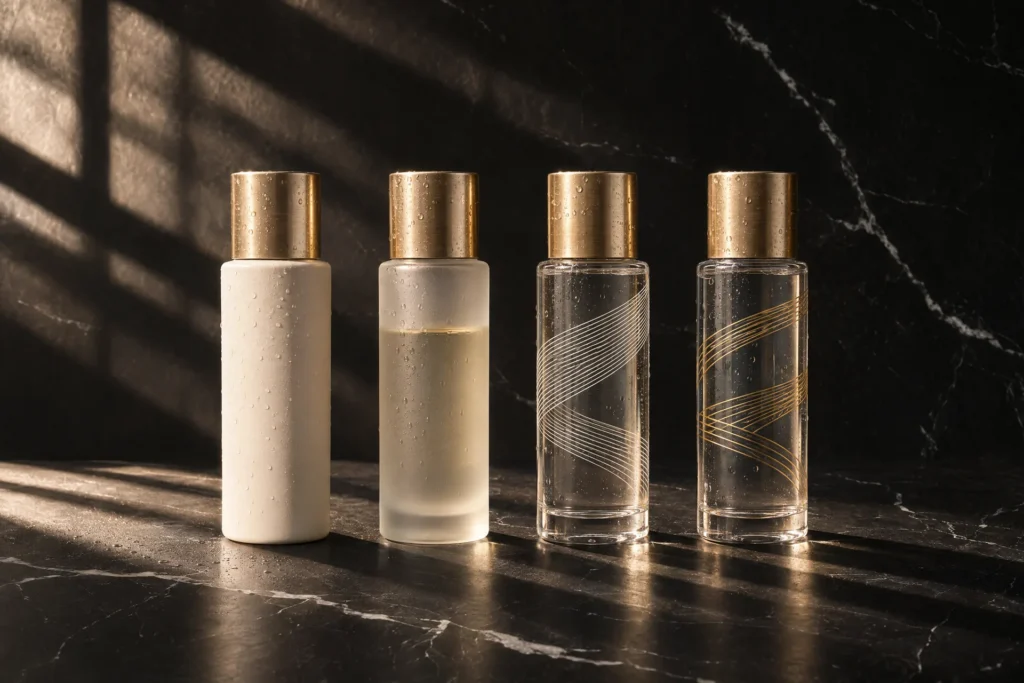
| Process | Visual and tactile effect | What to check on the sample |
|---|---|---|
| Spray lacquering | Solid opaque colour, semi-transparent, gradient or with a soft finish (soft-touch) | Lacquer adhesion, protection of the neck thread and resistance to scratches, alcohol and oils |
| Satin frosting (acid etching or frost lacquer) | Velvety matt surface that lets the product level show through | Even opacity and ease of cleaning when touched with fingers greasy with cream or oil |
| Direct screen printing | Text and graphics printed directly on the glass wall, slightly raised to the touch | Sharpness of small type on curves and resistance of the ink to rubbing |
| Hot foil stamping | Glossy metallic details (gold, silver, copper) applied with a foil | Edge precision on fine logos and compatibility with the underlying surface |
Legibility of text and durability in everyday use
Artwork should always be approved on a filled physical sample. Thin white or gold text that looks perfectly clear on the designer’s screen can become hard to read on a curved, glossy wall or in front of a light-coloured cream. A suitable area must also be left free for batch-number coding on the packaging line.
Mechanical and chemical resistance tests must then be carried out on the finished decoration: the bottle is handled with fingers covered in cosmetic, placed on wet surfaces and cleaned on the filling line. Testing the resistance of lacquers and inks in direct contact with the formula prevents the text from wearing off after a few weeks of use.
To keep the same colour on later reorders, a paper Pantone reference should always be accompanied by an approved physical sample (known as a PPS) on glass, because the same pigment looks different depending on the substrate and the thickness applied. Vestena builds PPS approval into its workflow as a mandatory milestone, to guarantee the result of production and therefore of the order.
7. Transport, packing and the end of life of the pack
The choice of bottle must also take into account everything that happens before and after filling, from plant logistics to final disposal.
Protection in transit and additional costs
Matt-lacquered, frosted or metallised bottles can get marked even before they are filled if they rub against each other on the way from the decorator to the contract filler. They therefore need suitable cardboard dividers, thermoformed trays or individual protection.
When comparing two quotes, it is therefore worth adding up all the items: price of the complete set, decoration, transport packaging for the filling line and the secondary protection needed for shipping to the customer, especially if the product is sold online.
Recyclability and refillable projects
Glass has a well-established recovery chain, but the environmental assessment covers the complete pack. Multi-material pumps that are hard to separate, very dark full-body lacquers or non-removable coatings can affect the sorting and recycling of the packaging.
The idea of offering a refillable glass bottle also needs concrete checks: a screw neck is not enough to call it a refill. You need to define which part is sold as the refill, how many times the pump can be reused while maintaining hygiene and dosing, and how easy the replacement is for the customer.
8. How to prepare the brief to choose glass with Vestena
To identify the right bottles quickly and avoid unnecessary sampling, it helps to gather some practical information about the project from the very first contact:
- Formula characteristics: indicative density or viscosity, any sensitivity to light and the presence of essential oils, alcohol or particular actives.
- Format and way of use: nominal capacity required (e.g. 15, 30, 50 or 100 ml), type of application and amount of product to dispense per press.
- Range extension: whether the bottle will remain a single item or be part of a coordinated line with several sizes.
- Contract filler’s requirements: any filling-line constraints on bottle shape, neck, closure system and batch marking.
- Quantities and aesthetic priorities: expected volumes for the first order and reference images, distinguishing essential requirements from those where alternatives can be considered.
Alongside catalogue selection, Vestena offers a scouting and custom development service through a network of qualified production partners. The catalogue lets you start from ready-configured solutions such as full sets, while scouting makes it possible to look for specific shapes, weights or accessories when the project has particular needs.
Asking Vestena for a selection of glass bottles based on a clear brief lets you compare a few targeted samples, check compatibility with the formula straight away and set up a solid supply for future reorders too.
Your project
Choosing your glass bottle
Share with Vestena the format, formula, expected quantities and goal of the project. They are the starting point for a relevant selection and sampling.
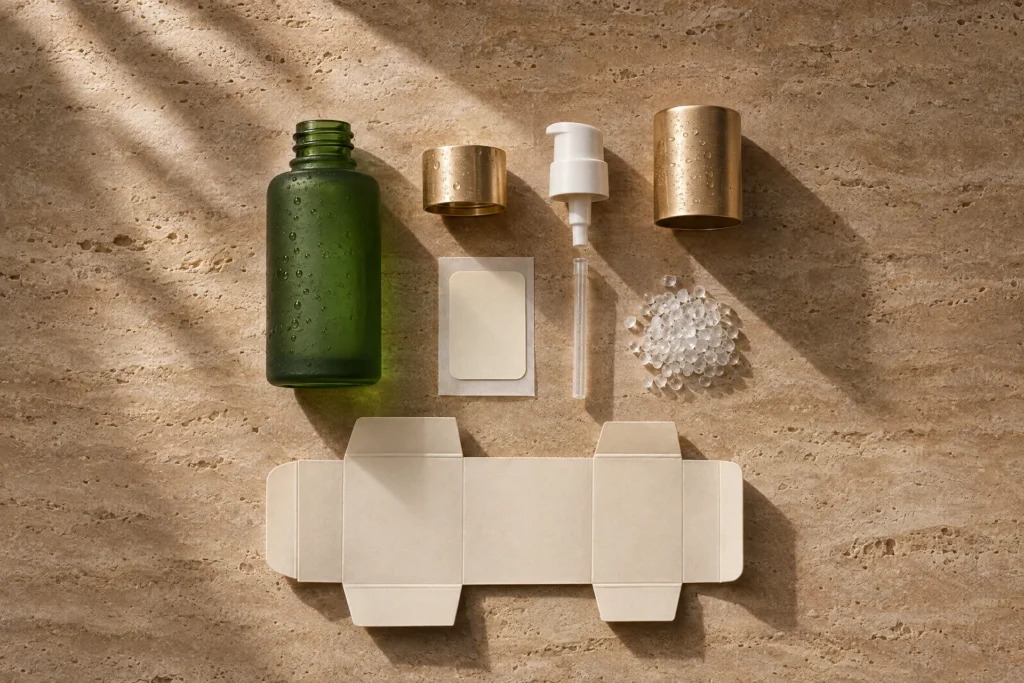
Cosmetic packaging artisans since 1977. We coordinate materials, decoration and lead times tailored to your project.

